
Sustainability as a Strategic Advantage: Key Insights from the 5th Monitor for Circular Fashion
Monitor for Circular Fashion SDA Bocconi
Today, Il Sole 24 Ore featured an article by Chiara Beghelli highlighting the main findings of the 5th edition of the Monitor for Circular Fashion SDA Bocconi, presented yesterday during the multistakeholder event Transform to Perform. The report offers a comprehensive overview of how fashion companies are navigating the green transition, turning sustainability and circularity into concrete competitive advantages.
The study, involving 27 companies across the industry, shows that sustainability has moved beyond narrative or compliance obligations. While media attention on sustainability may have lessened due to global economic uncertainties and a focus on operational efficiency, the underlying commitment of companies has only strengthened. As Francesca Romana Rinaldi, Director of the Monitor for Circular Fashion at SDA Bocconi, explains:
“Sustainability and circularity have become an integral part of companies, and are no longer part of a narrative or a legal obligation, but fuel a real competitive advantage.”
Among the key trends highlighted in the report:
- AI and digitalization: Advanced technologies are increasingly applied to improve traceability, optimize production processes, and enhance circularity across the supply chain.
- Support for SMEs: Smaller companies are receiving targeted support to implement circular strategies and integrate sustainable practices into their operations.
- Materials innovation: Research in sustainable materials is enabling brands to create products that are more durable, recyclable, and aligned with circular economy principles.
- Resale growth: The second-hand and resale markets are expanding rapidly, reflecting evolving consumer preferences and creating new business opportunities.
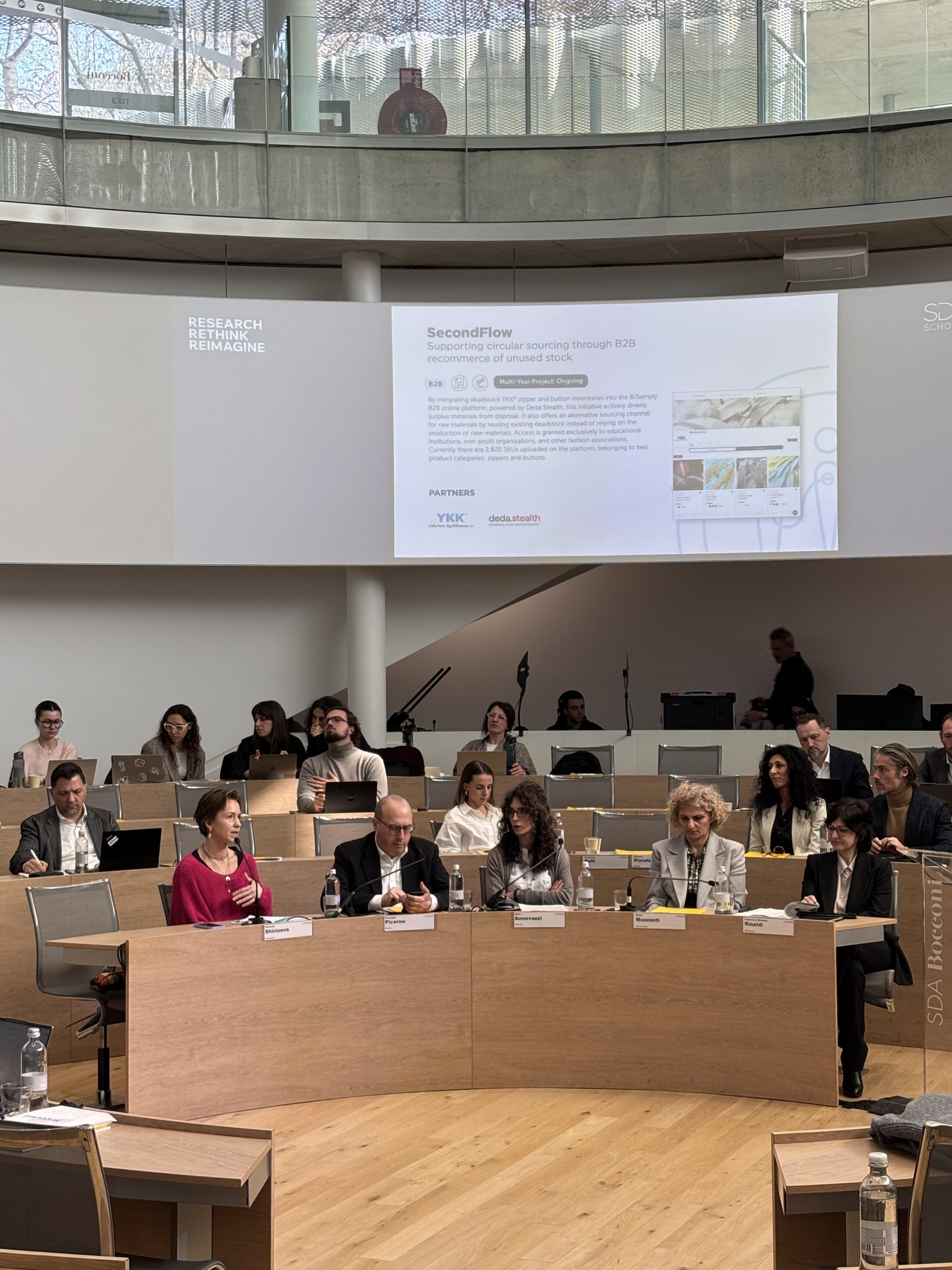
At B/Samply, we are proud to contribute to this transformation. One of the most exciting examples is the SecondFlow pilot project, developed in collaboration with YKK. By redistributing existing materials instead of producing new ones, 𝐒𝐞𝐜𝐨𝐧𝐝𝐅𝐥𝐨𝐰 provides a concrete example of circular economy in action, showing how digital innovation can reduce waste while creating new opportunities for the industry. By integrating innovative technology with industry expertise, the project demonstrates how circularity can be applied in practice, turning sustainability into tangible value for companies and consumers alike.
The Transform to Perform event also highlighted the importance of multi-stakeholder collaboration: brands, innovators, and academics came together to discuss these findings and explore how circularity can drive strategic growth. Initiatives like SecondFlow are concrete proof that digital innovation and partnerships are key to unlocking the potential of a circular fashion ecosystem.
Reports like the Monitor for Circular Fashion confirm that embracing sustainability and circularity is not only ethically and environmentally important but also a source of long-term competitiveness and differentiation in a rapidly changing market.
For more insights on how digital tools are supporting circularity in fashion, explore our community: B/Samply Community.